

Written by L. M. Land. Image courtesy of the United States Mint
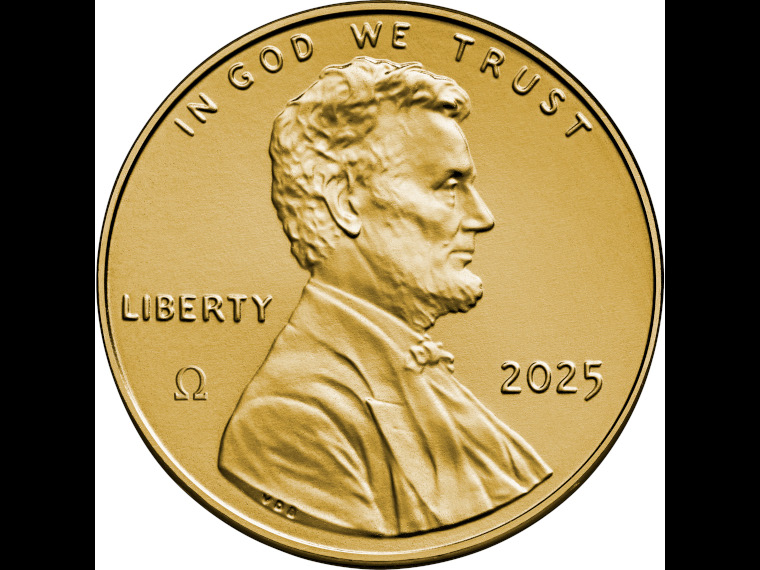
Caption: Shown is the 24K last strike penny, which will be auctioned off on December 11, 2025. Note the unique Omega (Ω) privy mark, which is on the last coins minted. Photo courtesy of the United States Mint
It may be a myth now, but those of us who are 50ish years old or older remember that the ubiquitous copper penny really, truly, would buy a couple of pieces of candy.
Now, after being part of everyday life for 232 years, the penny is no longer being produced.
In February 2025, President Trump directed the U.S. Treasury to stop producing pennies as part of a broader effort to cut unnecessary government spending. Over the past 10 years, the cost of producing each penny rose from 1.42 cents to 3.69 cents per penny, making it economically inefficient. Also, many people do not carry change today, preferring one of many types of card or online services to pay for items or services.
The United States Mint in Philadelphia hosted a ceremonial last cent strike on November 12, 2025, where United States Treasurer Brandon Beach struck the final, circulating one-cent coin.
“Today the Mint celebrates 232 years of penny manufacturing,” said Kristie McNally, acting Mint director.
She added: “While general production concludes today, the penny’s legacy lives on. As its usage in commerce continues to evolve, its significance in America’s story will endure.”
Existing pennies will remain legal tender. Retailers and other businesses can continue to price goods and services in one-cent increments. Banks and credit unions will continue to accept pennies as well.
The Mint also struck their collectible coin editions in November. Each set will be accompanied by a serialized Certificate of Authenticity. The final set, set number 232 (signifying the number of years the penny was in use), will also include the three original dies used to strike these coins, which bear a unique Omega (Ω) privy mark, signifying each coin is among the last of the circulating pennies ever struck by the Mint. Each set includes two circulating pennies, one from each of the Mint’s production facilities in Denver and Philadelphia and, for the first time ever, a 99.99% 24-karat gold uncirculated penny, also minted in Philadelphia.
Live bidding for these three-coin sets will take place on Thursday, December 11, 2025, auctioned by the Stack’s Bowers Galleries online.
United States Treasurer Brandon Beach and Mint Acting Director Kristie McNally operated the presses to strike the final Philadelphia-minted Omega coins, in recognition of their historic significance.
Before you dive into your coin jar, know that value is based on how pristine the coin is (no scratches or rubbed off sections), rarity and other factors. As there are currently 300 billion pennies still in circulation today, you might have a pricey penny in a jar, but it might have more value if you hold on to it for a bit.
You have to wonder how much our recent pennies will be worth in their coin-collecting future. In the Coinage Act of 1792, it was mandated that the penny be valued at 100th part of a dollar and contain precisely eleven penny-weights of copper, or 95% copper. From 1982 until November 2025, the penny has been 97.5% zinc with a 2.5% copper coating (which in my experience literally washes off after only one round in the wash machine). On the other hand, since many of the new coins will have no copper coating left in a few years, a truly mint-condition, post-1982 coin might be worth a lot. All this remains to be seen in the future, and illustrates potential complexities and guesswork of future coin value.
In the meantime, do you want to learn about coin collecting? It is a fun way to learn about history and what makes a coin valuable. The ‘2026 Red Book: A Guide Book of United States Coins’ would be a good start. Also check out the American Numismatic Association, the national coin collector’s society. There is a Flint chapter. See more info below.
About the United States Mint:
Congress created the United States Mint in 1792, and the Mint became part of the Department of the Treasury in 1873. As the Nation’s sole manufacturer of legal tender coinage, the Mint is responsible for producing circulating coinage for the Nation to conduct its trade and commerce. The Mint also produces numismatic (collectible) products, including proof, uncirculated, and commemorative coins; Congressional Gold Medals; silver and bronze medals; and silver and gold bullion coins. Its numismatic programs (like the coin auction mentioned above) are self-sustaining and operate at no cost to taxpayers. (The Federal Reserve distributes coins to banks and credit unions.)
Sources:
https://bankingjournal.aba.com/2025/11/u-s-mint-produces-last-penny/
https://www.aba.com/banking-topics/payments/penny-phaseout
https://en.wikipedia.org/wiki/Penny_(United_States_coin)
https://www.money.org/ten-rules/ Article about becoming a coin collector by Doug Winter, American Numismatic Association
Flint Flying Eagle Coin Club-Club Contact Daniel Freeland at 989. 843.5247, Email ksfdaf@sbcglobal.net
