


Written by Tanya Terry, with photos from Canva
Amanda Nothaft, director of data and analysis at Poverty Solutions at U-M, recently discussed with the Courier the concerning economic conditions in Michigan’s East region, particularly Flint, based on updated poverty and well-being data released on August 4, 2026. The East region shows slightly higher rates of uninsured adults, lower median incomes and higher poverty rates compared to state averages. Most notably, Flint has one of the highest, if not the highest, child poverty rates in the state.
Nothaft emphasized that a particularly concerning population is the “ALICE” group—Asset Limited, Income Constrained, Employed households—people who earn too much to qualify for government benefits but still struggle to make ends meet. These families face constant vulnerability to emergencies like car repairs or medical crises that can destabilize their entire economic situation.
Nothaft highlighted successful interventions like the Rx Kids program that began in Flint, which provides support during childbirth to help families maintain economic stability. Also, the community college connection programs, such as Michigan Reconnect, increase access to post-secondary education and career training.
“In Flint, one of the big things is connecting children graduating from high school to that next step,” shared Nothaft. “There’s a sociology we refer to, something called social capital. And if you don’t know someone who has made that transition from high school to additional education, that’s a new path to have to try to navigate on your own. And it can be very scary. So, helping people make that transition to sort of post-secondary, training and education is really important. And that can be a really fruitful place to intervene to improve adult outcomes.”
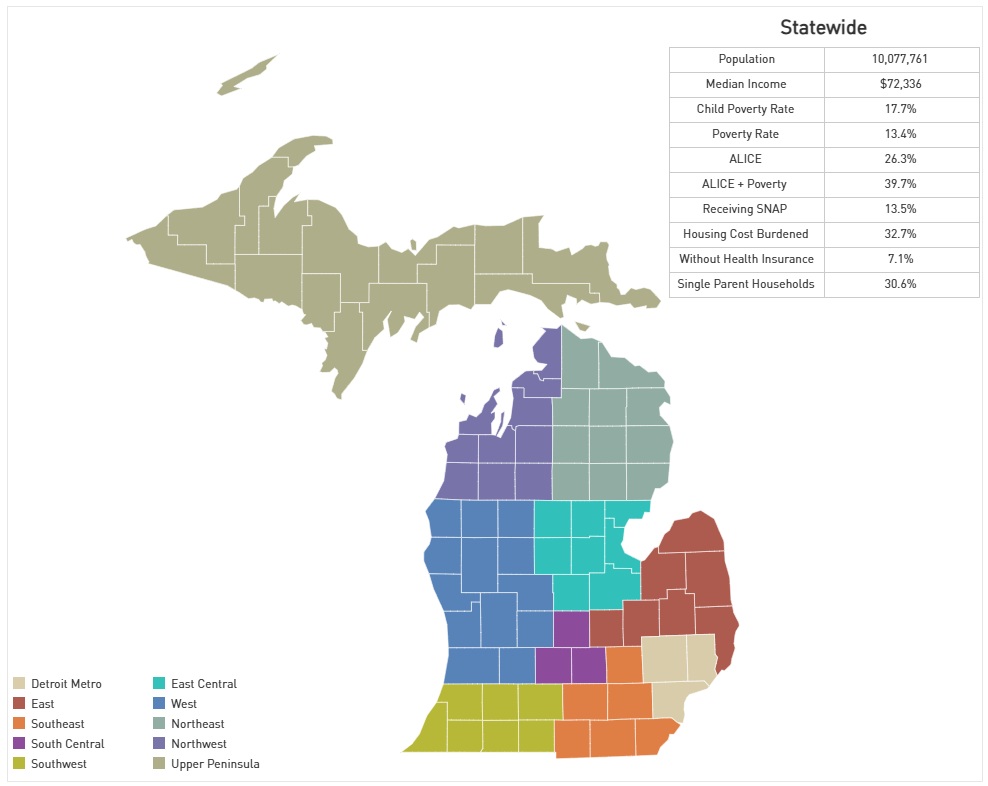
The Michigan Poverty and Well-Being Map, first introduced in 2019 and updated every two years, tracks eight key indicators: median household income, health insurance coverage, housing cost burden, child poverty, poverty rate, ALICE population, SNAP recipients and food insecurity. These metrics help policymakers and community members identify vulnerabilities and guide efforts to improve economic mobility.
Nothaft noted that while poverty often gets overlooked in Michigan with focus on Detroit and Flint, the surrounding Genesee County cities often face significant challenges, as well.
Northaft also pointed out that vibrant community initiatives are underway. She encouraged residents to advocate for policies and support anti-poverty coalitions working to connect systems and resources to address these economic disparities.
“There’s lots of effort going on all over the place, and I think bringing everyone together and pushing efforts in the same direction, and working together could have a really effect on things,” said Northaft. “We’re seeing some of that happen in Flint, and I think as that movement gets momentum, we could really see some wonderful work being done. ”